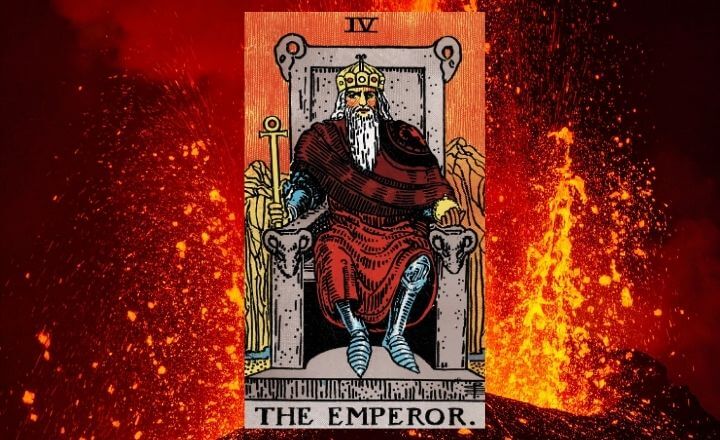
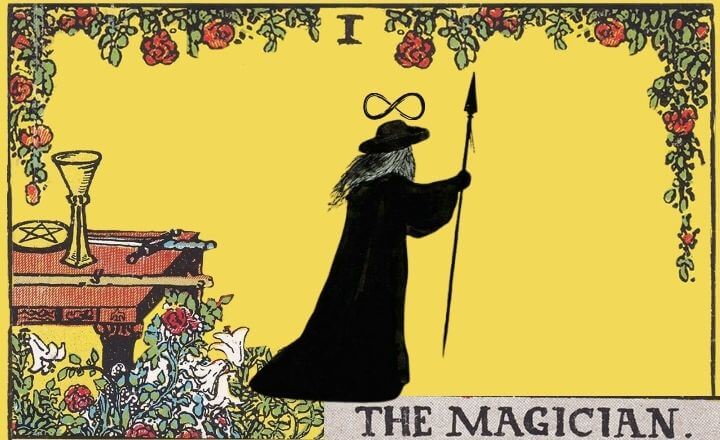
With the Hierophant card, we meet the master of esoteric teachings.
Many people approach tarot hoping for fortune-telling — to find out when they’ll meet their soulmate, get rich, or what awaits them next month. Yet tarot is not about predicting the future—it is not a tool of prophecy, but a mirror of the self.
Each card reflects a piece of your psyche — your fears, your desires, your patterns, your truth. Together, they trace the timeless map of the Hero’s Journey, the inner path of individuation where the Fool sets out and every step becomes a lesson in self-realization.
Every detail of a tarot card—its number, its color palette, its symbols—represents an archetype within you, carrying messages meant for your growth.
The answers you seek are already within you; tarot simply helps you see them more clearly.
In this series, we explore each card as a stage of the soul’s journey — helping you recognize the reflection in the mirror of your own becoming.
Celestial Father
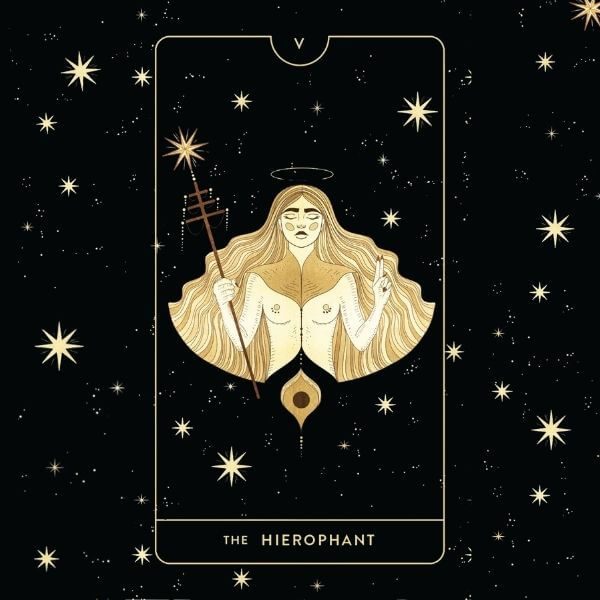
Like the High Priestess, the Hierophant sits between two pillars. Yet where hers unfurl like blossoms, his are sharper, more decidedly masculine. He sits centered in duality—this time with masculine agency.
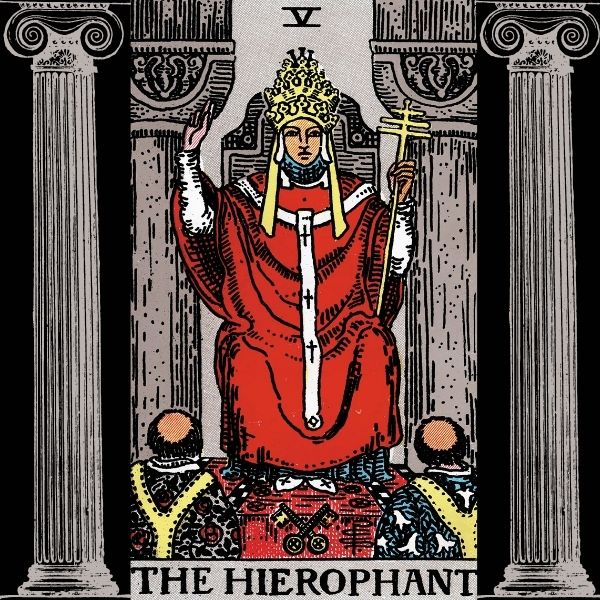
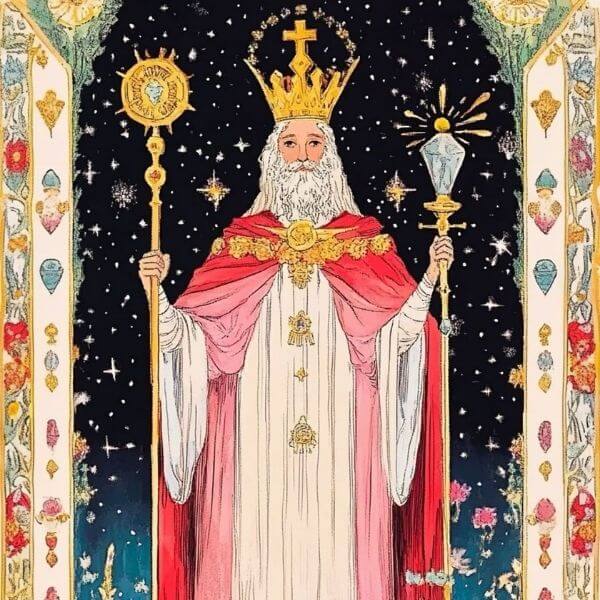
The Hierophant embodies the masculine expression of the High Priestess’s feminine principle. The masculine principle is traditionally signified by red; while the High Priestess is robed in blue, the Hierophant wears red. His vestments recall papal attire and clergy—fitting for a card that represents faith and spiritual authority.
The Master of Esoteric Teachings
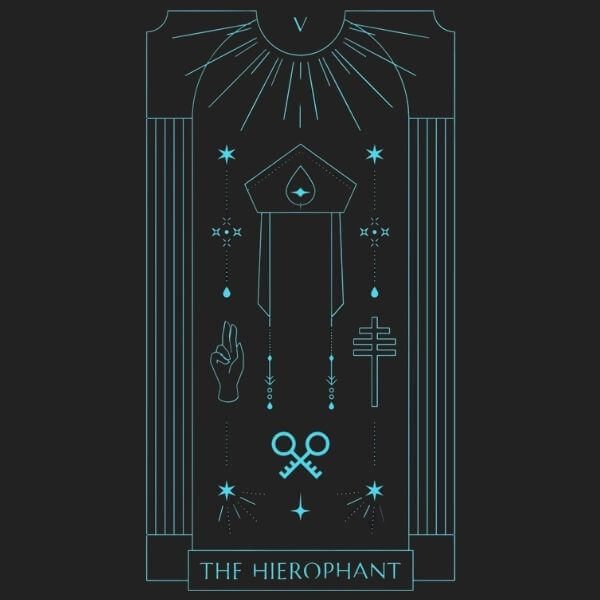
For the first time in the Major Arcana, we see a figure with both hands raised. The Hierophant’s hand mudra demonstrates the “rule of triple unity.” It reminds us of the union of above and below: three fingers up, two down—a sign for sacred love and sacred healing.
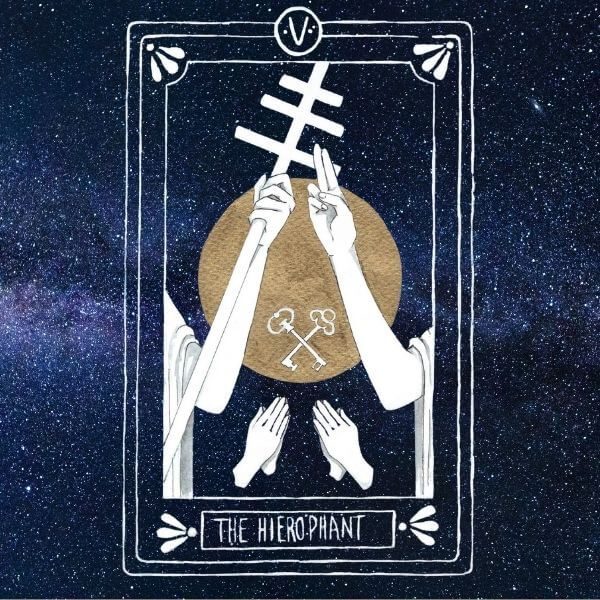
When this card appears, you can mirror the mudra with both hands during meditation as a way to attune to the celestial.
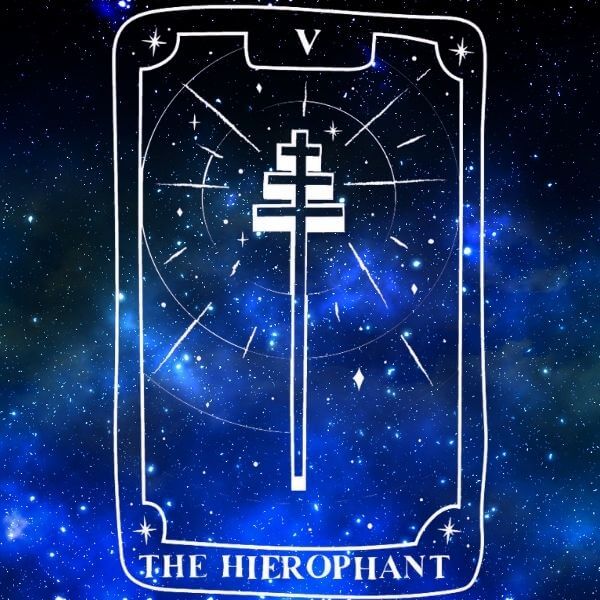
His scepter also carries a three-tiered form. It symbolizes looking through the window of unity and receiving knowledge from that vantage. The Hierophant’s task is to transmit celestial knowledge into the world. With this card, we meet the master of esoteric teachings.
Five & the Sense of Completion
The Hierophant arrives with the number 5, which signifies completion. As in the pentagram, the four elements are crowned by a fifth: quintessence (spirit). Hence the Hierophant asks:
“Where is your essence growing toward? How deeply are you loyal to your essence? When all elements convene, are you centered?”
What “Hierophant” Means
Hierophant comes from Ancient Greek. Hiero means sacred and phan means to show. So, he is “the one who makes the sacred visible.” An archetype devoted to offering and defending faith for the good of the whole. That’s why the card depicts two acolytes at his feet—those to whom he transmits knowledge. So ask yourself;
- What does my essence stand for?
- How do I express that to the world?
- What will people truly listen to from me?
- What kind of world am I advocating for?
Through its symbols, the Hierophant both teaches and tests you on these.
Shadow Side (A Cautionary Cassock)
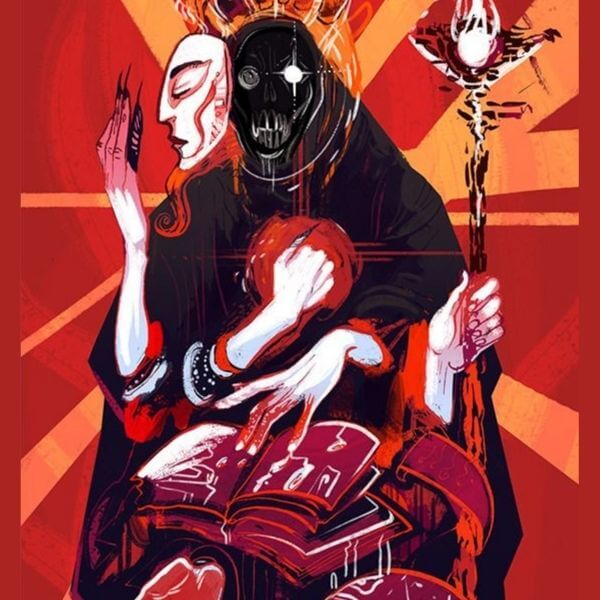
The Hierophant’s shadow is dogmatism. “This is my truth; I believe it,” stated as a blinkered, narrow view, is the archetype’s pitfall. The card highlights where we’re rigid, opinion-locked, or blinded by belief.
The Pinecone Crown
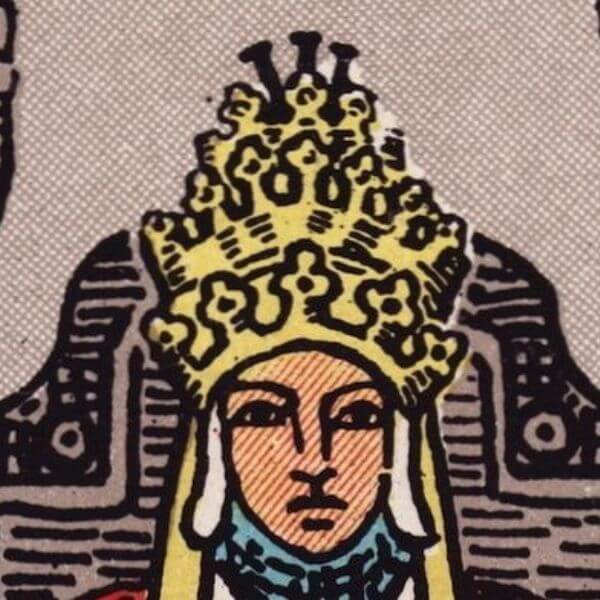
The Hierophant’s crown, like his scepter and mudra, is three-tiered, yet in full it resembles a pinecone—a universal emblem of the pineal gland.
The pineal gland is a small endocrine gland within the brain. Ancient peoples regarded it as the “seat of the soul.” When activated, it heightens intuition—a gateway to unity. It is the key to perceiving the realm behind the veil that we encounter with the High Priestess.
When the pineal calcifies, it diminishes two crucial hormones: serotonin (day/sun) and melatonin (night/dark). One is linked with the “masculine,” the other with the “feminine.” If blocked, the body loses balance—sometimes contributing to depressive states.
To take care of your pineal, choose fluoride-free toothpaste. You may also place stones like amethyst, rose quartz, and clear quartz in water (as traditionally practiced) to “wake” the water’s memory, reduce potential chemical load, and keep the body—bearer of pure information—clear.
The Healer Archetype
The Hierophant carries the “Wounded Healer” (Chiron) archetype.
Chiron—the centaur, half-horse, half-human—was abandoned by his mother at birth and left to the forest. His first wound: not belonging.
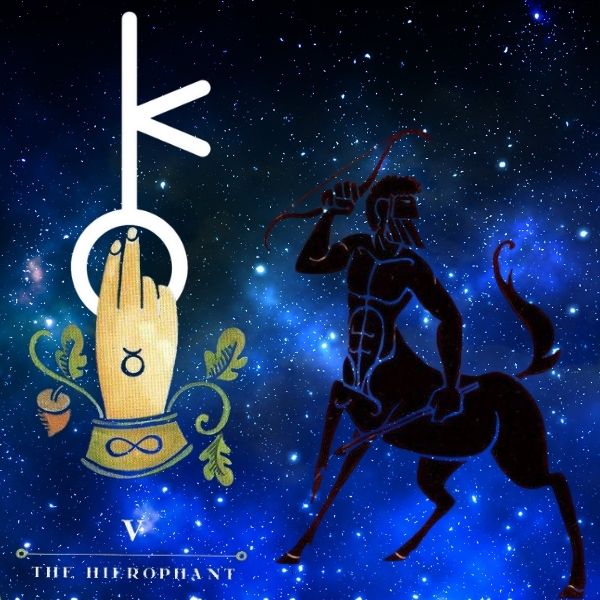
Nature sheltered, raised, and taught him; in turn, he mastered nature’s wisdom. He became a powerful healer; gods and goddesses sent their children—Heracles, Achilles, and others—to learn from him.
Chiron learned to heal through his childhood wound. The Hierophant brings the same wisdom:
“Where you were wounded is where your healing is born. Your deepest wound can be your deepest wisdom.”
The High Priestess resonates with the North Node; the Hierophant resonates with Chiron. Thus, when the Hierophant appears, it’s meaningful to examine Chiron’s placement in your natal chart. Where did life score the deepest wound? What lesson lives there—money, family, self-worth? Healing tends to flow from the house/sign where Chiron resides.
Keys of Heaven and Earth
It is no coincidence that Chiron’s glyph in astrology is also a key: Chiron is the key—and the heart—of the chart. At his feet lie two crossed keys, recalling Saint Peter’s words:
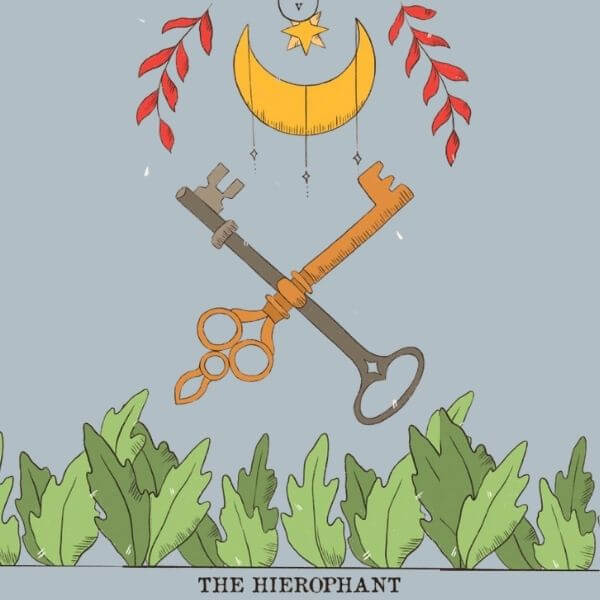
“I will give unto thee the keys of the kingdom of heaven: and whatsoever thou shalt bind on earth shall be bound in heaven; and whatsoever thou shalt loose on earth shall be loosed in heaven.”
These are the keys of above and below—the gates of the celestial and material worlds. The card reminds you that whatever you transform and heal in this world resonates through all times.
The Hierophant’s Prompts
- Look behind the veil
- Which rules are you afraid to break?
- Watch your judgments: are you acting from what you were taught—or from your essence?
Element & The Journey
The Hierophant belongs to the Air element—the realm of inspiration and ideas. He transmits that inspiration.
What was seeded with the Magician now matures into mastery with the Hierophant. In the hero’s journey, this card marks a deeper threshold.
With the fifth card, the Fool reaches a sense of completion and is ready to set out alone. The Hierophant prepares you to accept responsibility for that path.
Hierophant’s Stone: Jade
Jade means “wisdom within peace.”
- Works best at the heart chakra—wear it on a long chain at heart level.
- Harmonizes mind, body, and spirit.
- Under the pillow, it activates dreams and offers guidance there.
- Soothes suppressed anger and brings calm.
Final Word
The Hierophant teaches:
Faith, wisdom, and knowledge are best transmitted not with rigidity, but with compassion.
Healing does not arrive from outside; it rises from our own essence.
And the bridge between the celestial and the earthly? It’s us.