A sacred shortcut for the Hierophant card’s meaning if you don’t have time for the whole sermon.
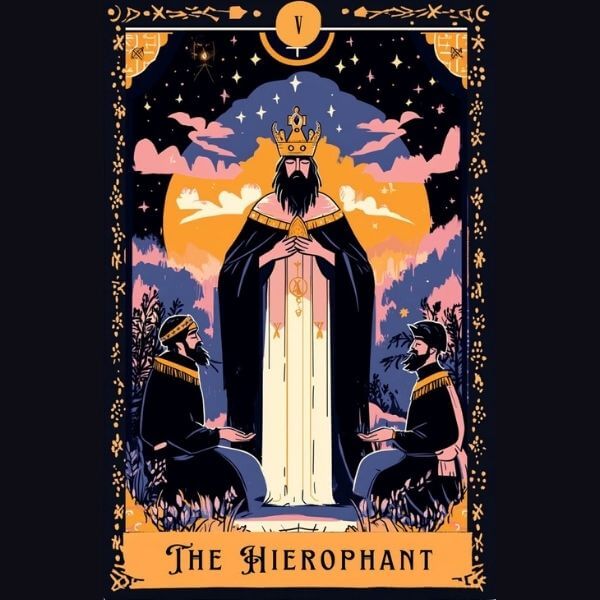
The Hierophant — the Celestial Father of the Tarot. Draped in papal red and crowned with sacred geometry, he is the voice of faith turned inward: the spiritual teacher who doesn’t just preach faith but translates divine order into human understanding.
With this card, we meet the Master of Esoteric Teachings — When this card appears, it’s less about bowing to authority and more about asking yourself: What is sacred to me—and am I living by it?
Archetype of The Hierophant
The Hierophant is the Wounded Healer. As Chiron in mythology, he is the teacher of gods and mortals. His wound becomes his wisdom, his exile his enlightenment. The Hierophant brings the same wisdom:
“Where you were wounded is where your healing is born.”
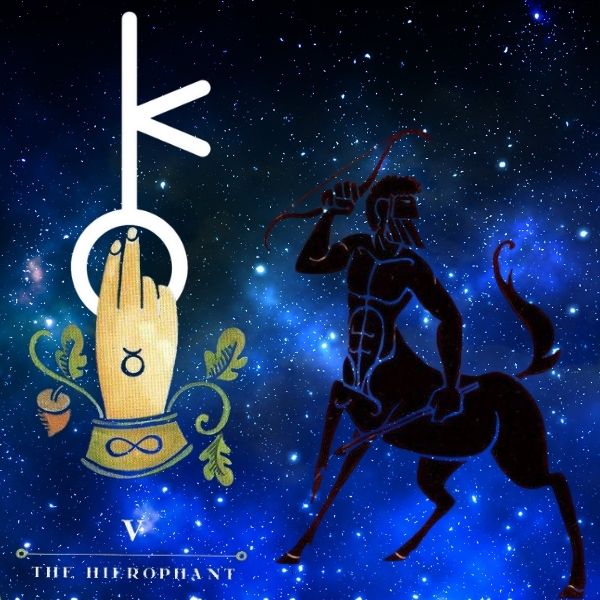
The Hierophant helps you locate the wound and reminds you that the power to heal it lies within.
When this card appears, check your Chiron placement in your natal chart. Through The Hierophant, it can help you locate the wound and remind you that the power to heal it lies within.
Energy It Brings
The Hierophant brings the current of alignment — the marriage of heaven and earth. His energy asks you to unify your beliefs/wounds with your behavior, to let your essence guide your actions.
He arrives when you are ready to channel divine knowledge into tangible reality. What began as faith becomes form. What was whispered by the High Priestess is now spoken aloud.
When “Hierophant” appears, ask yourself;
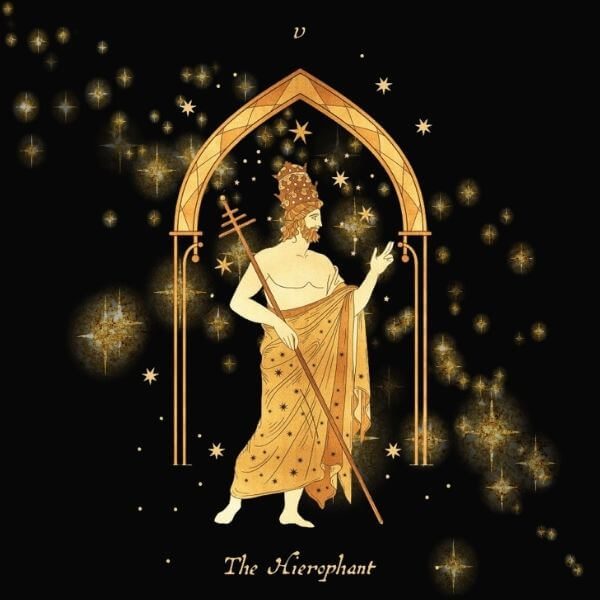
Hierophant comes from Ancient Greek. Hiero means sacred and phan means to show. He is “the one who makes the sacred visible.” So, when you see him ask yourself;
- What does my essence stand for?
- How do I express that to the world?
- What will people truly listen to from me?
- What kind of world am I advocating for?
- Can you look behind the veil?
- Which rules are you afraid to break?
- Watch your judgments: are you acting from what you were taught—or from your essence?
Colors & Meaning
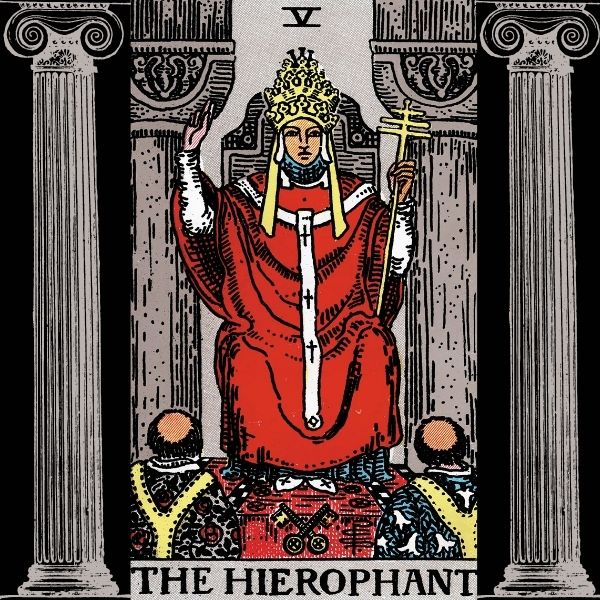
- Crimson Red: passion, love, will
All red his garments recall clergy robes; bring masculine principle, will to create.
- Blue: mystery, stillness, flow, subcounscious
But inside the red robe we see a blue cloth; it means this will comes from the collective subconscious.
- Yellow: enlightenment, energy, growth
His crown and staff are in yellow. This symbolizes that he is on a path toward enlightenment. In tarot, red is earthly, while yellow is the divine color.
Symbols & What They Represent
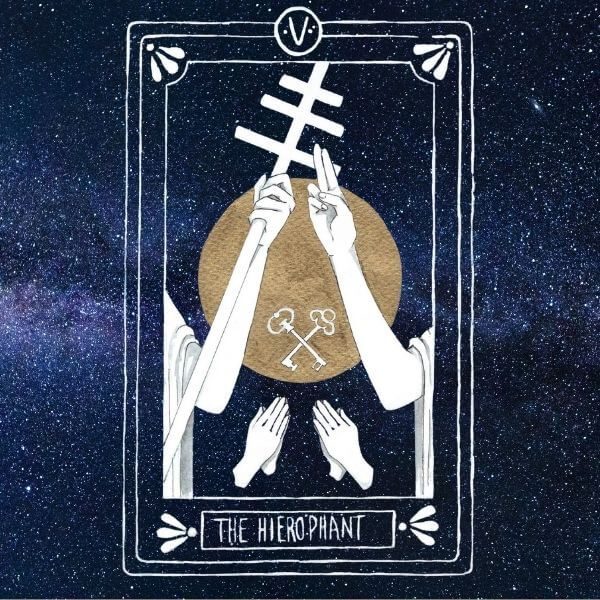
- Mudra: three fingers up, two down demonstrates the “rule of triple unity” — union of heaven and earth; sacred healing gesture. You can use during meditation
- Triple-tiered staff: the three planes of existence (spirit, mind, matter) connected through divine law.
- Crown: The Hierophant’s crown is not about rank — it is about illumination.
Shaped like a pinecone — the awakened pineal gland, seat of the soul, gateway to higher consciousness. It is the key to perceiving the realm behind the veil that we encounter with the High Priestess. - Twin pillars: same duality as the High Priestess, but now embodied in active, masculine order.
- Keys at his feet: The keys to the gates of the celestial and material worlds. The card reminds you that whatever you transform and heal in this world will heal in celestial world and resonates through all times.
Chiron’s glyph in astrology is also a key. Because Chiron is the key—and the heart—of the chart.
Number & Meaning
5 — the Fifth Element: Essence.
Four represents the known world — the elements, the stable square of life. Five breaks that order, adding spirit. It’s the number that asks:
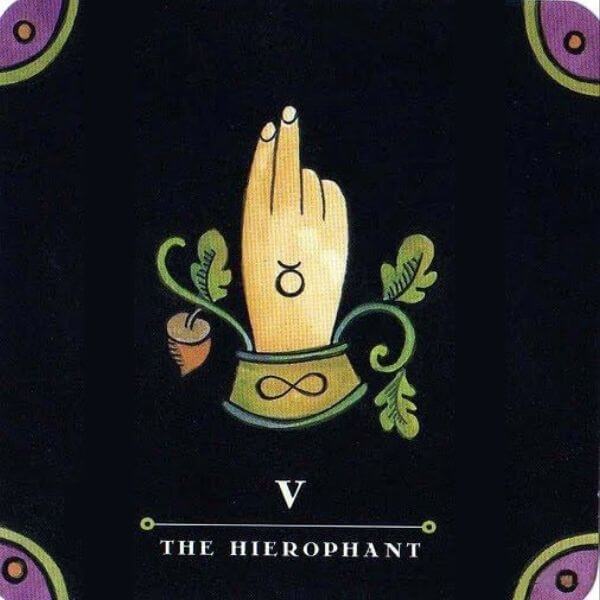
Are you centered in your essence? What truth are you expressing through being alive?
The Dark Side – Upside Down Meaning
When the Hierophant’s light dims, wisdom turns to dogma.
The sacred becomes a rulebook, and truth becomes law. In its shadow form, this card warns of blind obedience, rigidity, and self-righteous certainty — the voice that says, “I’m right because I believe it.”
Reversed, the Hierophant asks: Where have I mistaken control for faith?
The Hierophant in Yes/No Questions
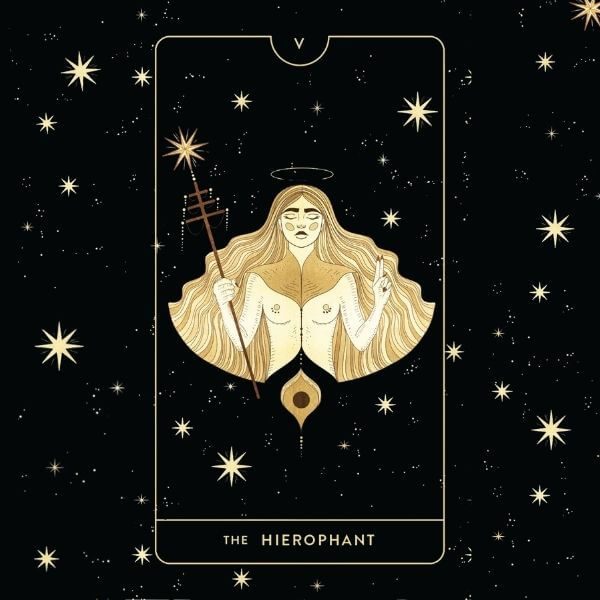
The Hierophant’s answer is Maybe — never absolute, always conditional.
He speaks through alignment, not certainty. If your question honors your truth, his silence hums “yes.”
If it arises from fear, imitation, or borrowed belief, it gently bends toward “no.”
But most often, the Hierophant simply says: Pause.
Revisit your intention. Let your inner law decide.
The Hierophan Stone: Jade
Jade is the Hierophant’s sacred ally — wisdom within peace.
- Best worn at heart level to harmonize body, mind, and spirit.
- Under the pillow, it opens dream channels and invites sacred instruction.
- Dissolves suppressed anger; brings calm authority and gentle balance.
- Carry it when teaching, healing, or confronting belief systems that test your patience.
Inspirations to Understand the Card
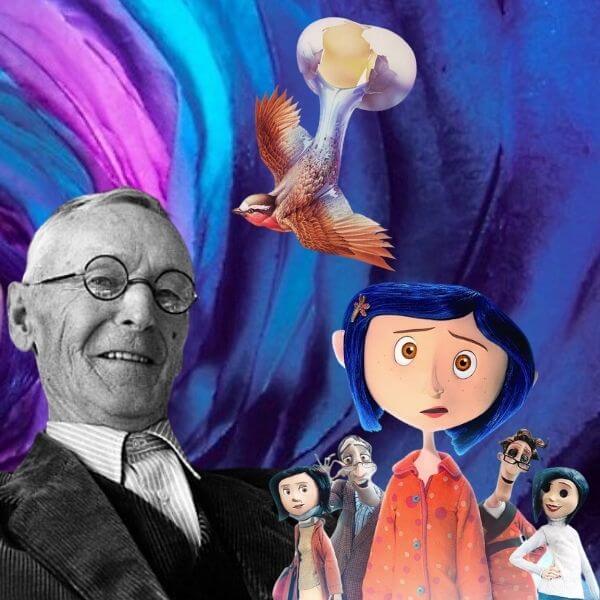
Watch: Coraline — A story where the four celestial parents (High Priestess, Empress, Hierophant, Emperor) echo through symbols of guidance and control. When Coraline’s parents were too busy to play with her, she found herself other parents.
Between her two sets of parents — earthly and otherworldly — she learns what every soul on the archetypal path must face: to break away from both comfort and control, and to walk her own way.
Read: Demian by Hermann Hesse — Demian is the story of becoming — the inner war that forges individuality. Hesse’s protagonist, Sinclair, walks through light and shadow to discover his own truth, mirroring the archetypal path of self-realization.
You can check out Coventum’s Quick Tarot Guide Series: The Hierophant — explore archetype to-the-point information.