The Emperor doesn’t ask for permission — he builds the throne.
Many people approach tarot hoping for fortune-telling — to find out when they’ll meet their soulmate, get rich, or what awaits them next month. Yet tarot is not about predicting the future—it is not a tool of prophecy, but a mirror of the self.
Each card reflects a piece of your psyche — your fears, your desires, your patterns, your truth. Together, they trace the timeless map of the Hero’s Journey, the inner path of individuation where the Fool sets out and every step becomes a lesson in self-realization.
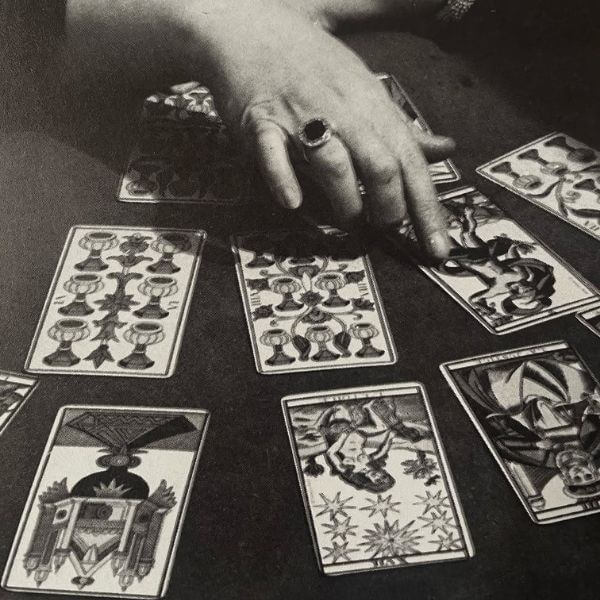
Every detail of a tarot card—its number, its color palette, its symbols—represents an archetype within you, carrying messages meant for your growth.
The answers you seek are already within you; tarot simply helps you see them more clearly.
In this series, we explore each card as a stage of the soul’s journey — helping you recognize the reflection in the mirror of your own becoming.
The Emperor’s Presence
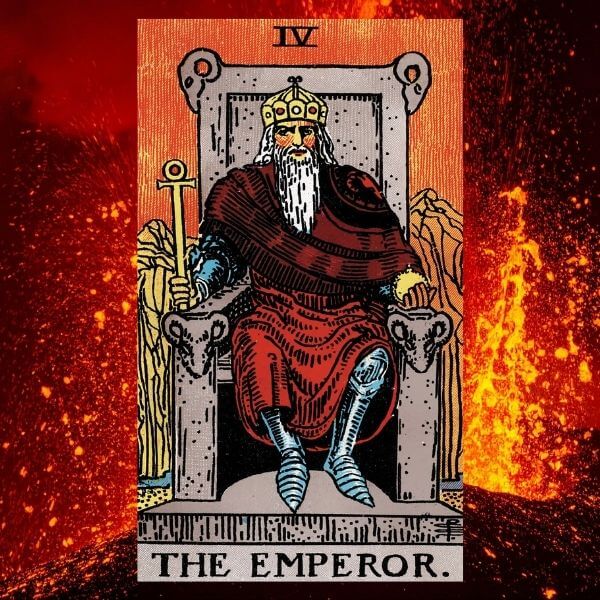
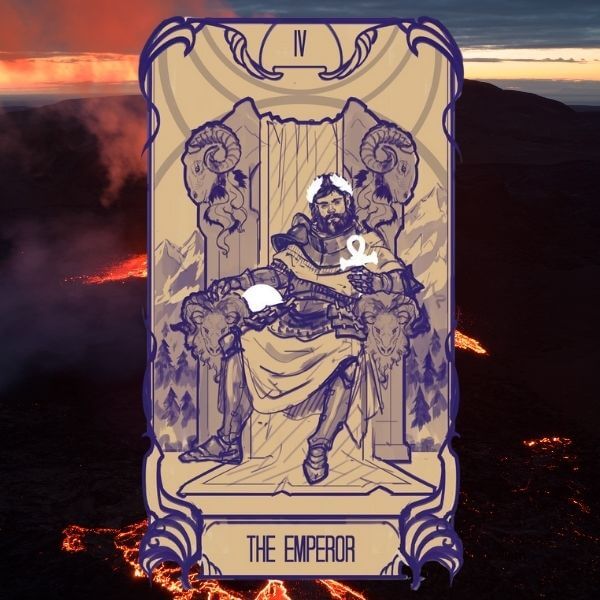
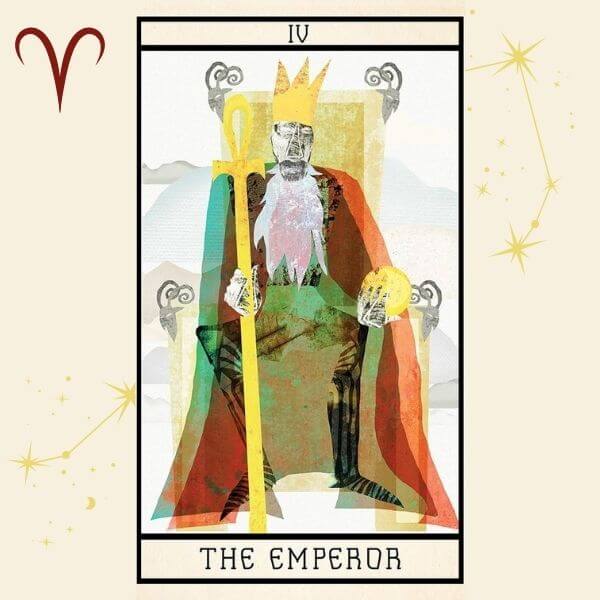
The Emperor greets us in a field of vivid reds, in all his majesty. At first glance he reminds us of fire, the power of fire, movement, and the capacity to take action. The background of the card feels dynamic, as if much has already happened—steps have been taken—and the Emperor appears to emphasize the principle of revitalizing and staying active so that after each step, the next one can follow.
Like all our celestial parents (the High Priestess, the Empress, the Hierophant, and the Emperor), the figure in the card is seated. His red garment envelops him completely. Yet we can see the armor beneath at his feet. He is ready for battle! With all his grandeur and his beard, he is a figure declaring, “I have matured.”
In tarot, red always brings action. Yet the Emperor is seated—because he is not in a hurry. He is mature enough not to spring into movement immediately. This contrast tells us:
“I sit atop everything, upon my throne. But if something is required, I am ready to fight.”
In short, we face a leader—calm yet cautious—armor beneath the robe, ready to move at any moment. Thus the Emperor represents being prepared to lead when needed and to fight when needed.
The Emperor Historical Archetype
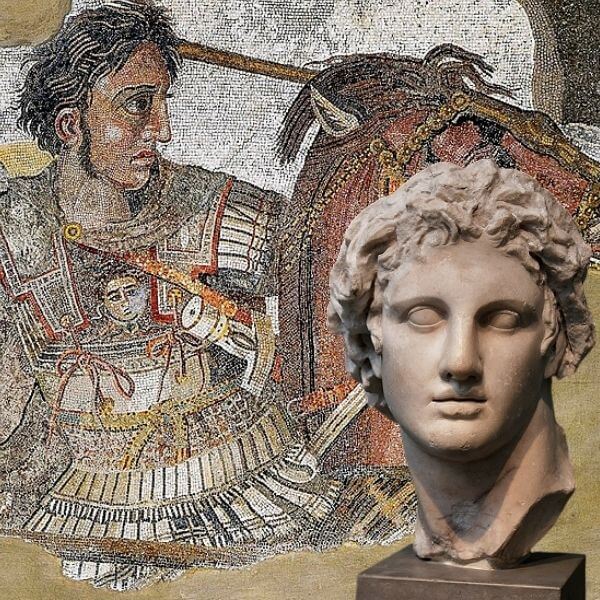
One of the best-known embodiments of the Emperor archetype is Alexander the Great.
By the age of 33, he had built an empire of three million square kilometers. Few figures could represent this card and its archetype better.
Of Rams and War Dances
Yes, the Emperor is a true leader, and he arrives bearing all the symbols of that archetype. There are four rams on his throne—the same as the number on the card. The ram is associated with Ares—the Empress’s archetypal storyline connects to Persephone.
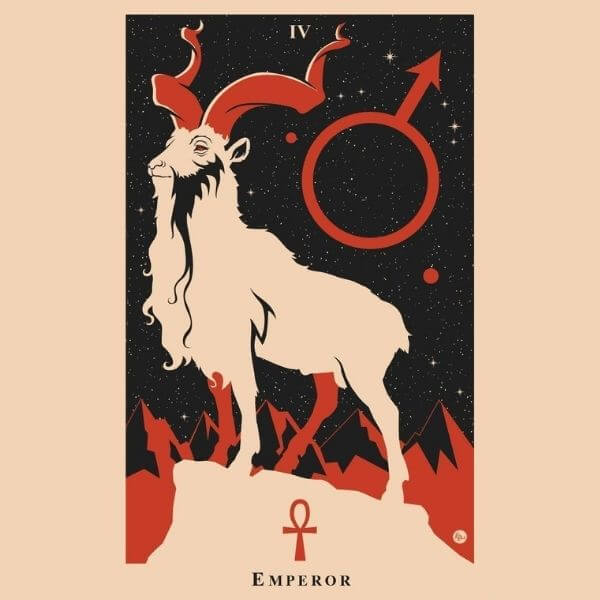
On the Empress card, the crown holds twelve stars—the twelve signs. Aries is the first sign of the Zodiac, the initiator, the one that begins things. Therefore the ram is a symbol that brings leadership and initiative.
We should remember that the fire element, by its nature, contains aggression. Ares is a war god, after all. Yet—though rarely mentioned—he is also known to love dancing. This often-overlooked detail changes everything: Ares’s fire also reminds us to dance with life rather than wage war on it—and maturity brings this transformation.
The Sacred Spiral of Growth
The ram is a sacred animal in many ancient cultures. Especially within Great Mother traditions, it was believed to be the goddess’s protector. The ram brings progress, growth, and guidance.
Its horns curl inward like spirals—echoing the progress and cyclicality we discussed in the Fool card. This is the energy of expansion, opening, and development.
Beard and Maturity
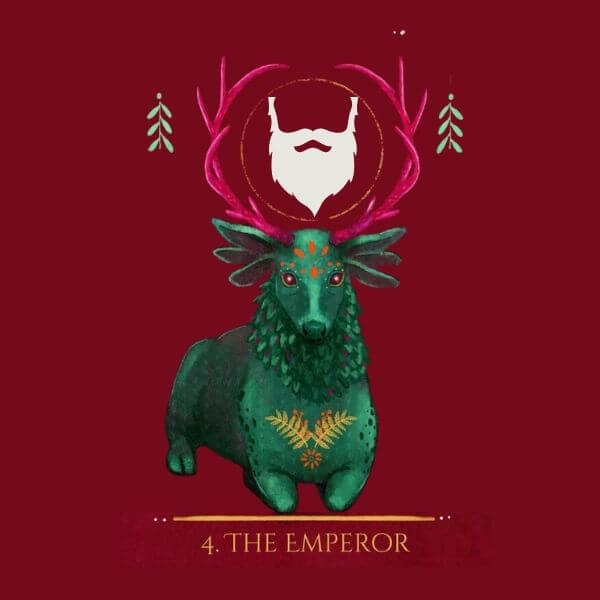
Seeing a beard on a tarot figure signals a stage of maturity. It indicates someone who has drawn out the essence of all experiences and proceeds with wisdom.
The two cards before the Emperor (the High Priestess and the Empress) are feminine-principle cards, concerned with inspiration, intuition, and compassion—receptive to knowledge from the cosmos.
The Emperor embodies the masculine principle—active, giving, mobile; an energy that works and advances.
When the Sun Wears Armor
The feminine is symbolized by rounded forms; it is inclusive, expansive, and holistic (like the orb in the Empress’s hand).
The masculine divides, differentiates, and analyzes; it operates on a more linear plane. Its symbols are often long, phallic objects such as the scepter.
This also introduces a view of time. Masculine energy perceives time as a bounded, planned line: it sets limits, makes plans, creates space.
Feminine energy perceives time as holistic; everything exists together in the now.
Scepters, the Orb, and the Ankh
In that sense we see masculine and feminine symbols on the Empress card. The scepter is in the left hand—carrying the feminine principle on the feminine side. The right side corresponds to the masculine.
The scepter is in the right hand. Moreover, this scepter is different; it resembles a large Ankh.
The Ankh, in Ancient Egypt, symbolizes both masculine and feminine. The long bar represents the phallic (masculine) aspect; the loop at the top represents the feminine. According to the Egyptians, the union of these two is the key that opens the realms beyond. The integration of these energies brings balance.
In the Emperor’s left hand we see an orb—the world rests in his palm. The orb (a round form) again represents the feminine, that is, mercy and love. Thus the Emperor declares a capacity to hold the world’s knowledge with love.
Gaze Fixed on Tomorrow
The High Priestess and the Empress look directly at us. The Emperor looks to the right. In tarot, the right side symbolizes the future, and the left the past.
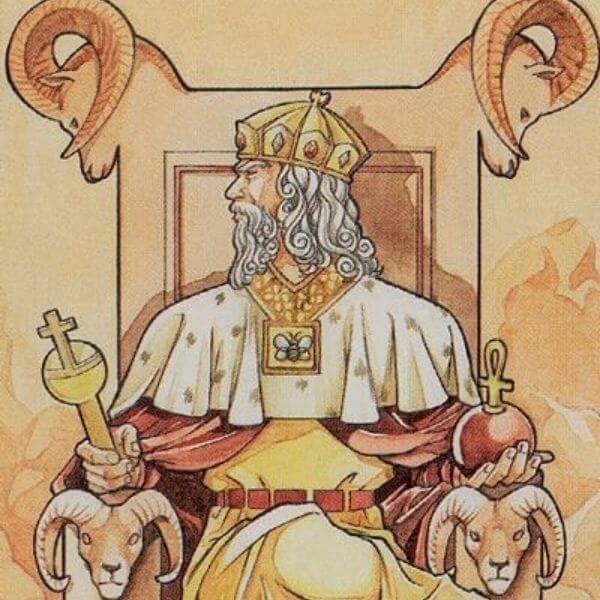
Therefore, the Emperor’s rightward gaze shows he is a visionary, his eyes on the future. From his seat he thinks and creates what is to come. He seems to say, “I’m seated, but my work isn’t finished; my fire hasn’t gone out.” The armor waiting beneath him is proof.
The Empress stands amid greens and nature, representing healing, fertility, and life.
The Emperor stands amid reds, in the energy of fire and earth, not of nature. He seems to be at a mountain peak, which symbolizes the ability to see from above, to grasp the big picture.
If we’re drowning in details and cannot see the larger picture, the Emperor may be appearing—or we can invite his energy to help us.
The Shadow on the Throne
The shadow of this card isn’t hard to guess: tyranny, dictatorship, and the abuse of power.
He can become someone who uses all his maturity and knowledge for self-interest.
Or the opposite: an impotent prince.
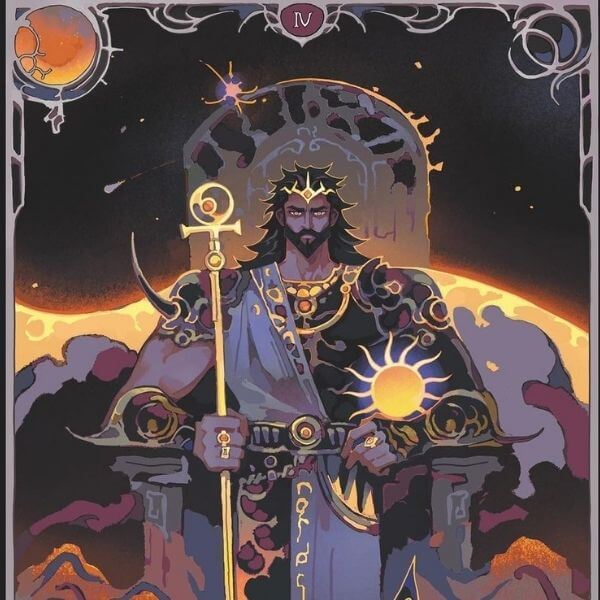
The dark face of the Emperor hides weakness behind fear and oppression, masking helplessness with control.
The Father Archetype and the Weight of Legacy
In tarot, our celestial parents are the High Priestess and the Hierophant.
In the material world, the Emperor and Empress embody mother and father.
Because it carries the energy of the earthly father, the Emperor represents our relationship with our father. He asks:
“What have you taken from the father role model in this life, and what are you working through?”
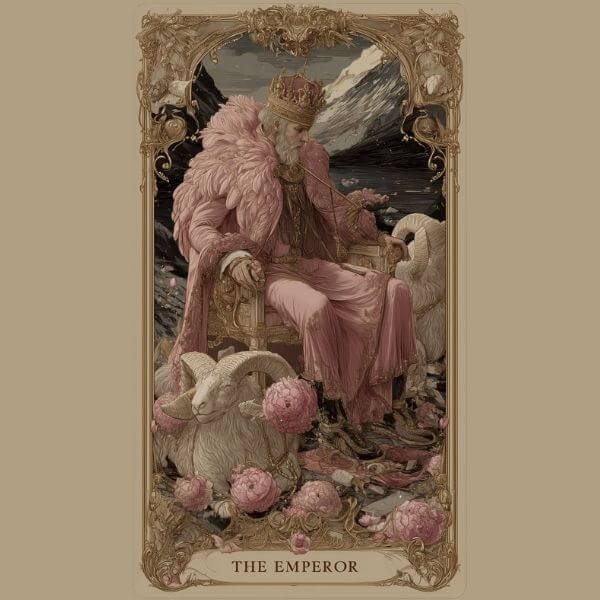
The Empress concerns what we receive from the mother.
The Emperor asks, “What have you taken from your father?”
He helps us notice what we’ve inherited from the father role model and view it from above.
When The Emperor appears, ask yourself:
- What is my relationship with my father like?
- Who is the dominant figure in my family?
- What is my attitude toward authority?
- What does authority mean to me—order-bringing or controlling?
- Can I build my own kingdom, on my own path?
- And am I ready to carry the crown?
From Seed to Empire
With the Magician, we placed all the elements before us and began a creation—we found an idea, planted a seed.
Then the High Priestess taught us to withdraw, to be patient, to let the seed grow—to let it rest in the mind and the womb and work slowly.
Next, the Empress said, “Now birth has happened,” and your dream was born. With all her abundance, she taught you to nourish and protect it so it could grow.
Now the Emperor shows standing on one’s own feet and becoming a leader. You wished for something, and it was born. Now all the responsibility is yours. It’s in your hands to keep your creation standing.
The Emperor asks you to break the parts of yourself you believe are “unbreakable,” and to become conscious of your responsibilities. He reminds you to take responsibility for your life—one of the most fundamental teachings of this card.
When this card appears, examine:
- What kind of law-enforcer am I?
- Can I be flexible?
- Am I open to advice?
- Am I stubborn?
- Can I take criticism?
The Emperor’s Stone: Fire Agate
The stone of this card is fire agate.
- It brings a sense of endurance and focus.
- It helps with procrastination.
- Keeping it in the bedroom may make sleep difficult, because it energizes when held.
- It provides safety and protection, like the Emperor’s armor.
- It works on the root chakra; along the spine it balances energy and gives one posture.
The Emperor‘s Number the Pillars of Power
The card’s number is four. Three is celestial; four is material.
Four symbolizes the four elements (fire, water, air, earth) and the four directions.
Everything stands upon four pillars. Thus this card is the foundation of both worldly order and personal leadership.
It burns with red fire yet moves with maturity.
He sits atop the mountain, yet is still ready to walk.
The Emperor’s teaching: “Be a king, but be a wise one.”
You can check out Coventum’s Quick Tarot Guide Series: The Emperor — explore archetype to-the-point information.